
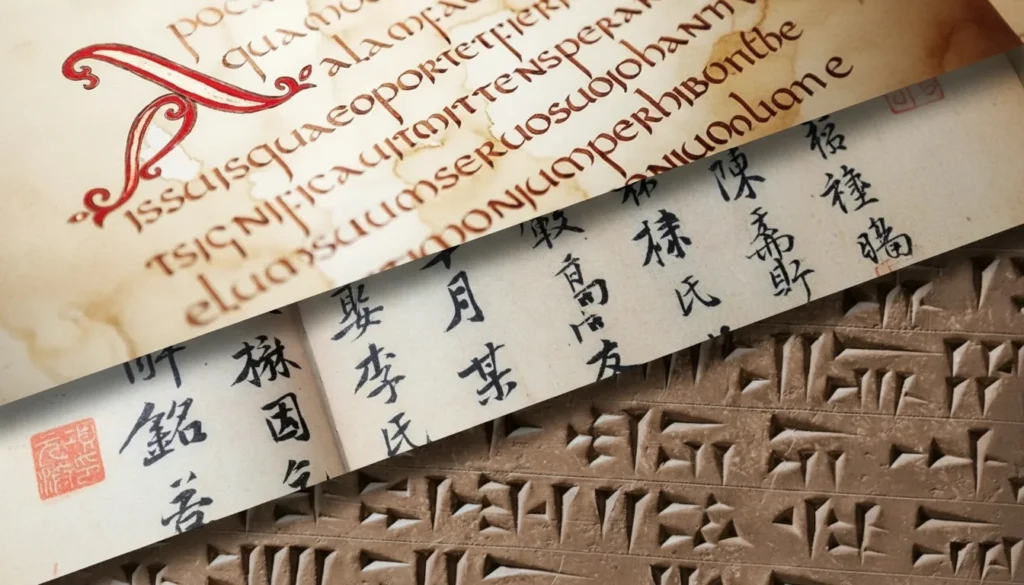
Every language has its own way of representing sound and meaning. Some use alphabets like English and Spanish, others use characters like Chinese, and many rely on beautiful hybrid systems in between. Understanding the world’s main writing systems helps you learn languages faster, read confidently, and appreciate the culture behind each script.
What is a writing system?
A writing system is a set of symbols used to represent language visually. These symbols can show sounds, ideas, or a mix of both. Studying these systems gives you a clearer path into pronunciation, vocabulary, and structure when learning a new language.
The major types of writing systems
Alphabets
Alphabets use symbols to represent individual sounds (phonemes). Each letter typically corresponds to one sound, making them straightforward for beginners.
- Latin alphabet: English, Spanish, French, Italian, German.
- Cyrillic alphabet: Russian, Ukrainian, Bulgarian, Serbian.
- Greek alphabet: Greek.
Abjads
Abjads primarily represent consonants. Vowels are added with optional marks or left for context.
- Arabic script: Arabic, Persian, Urdu.
- Hebrew script: Hebrew, Yiddish (modified).
Abugidas
Abugidas combine consonant symbols with vowel marks, creating a flow between sound and writing.
- Devanagari: Hindi, Nepali.
- Bengali script: Bengali.
- Ge‘ez: Amharic, Tigrinya.
Syllabaries
Each symbol represents a full syllable rather than a single sound.
- Hiragana and Katakana: Japanese.
- Cherokee syllabary: Cherokee.
Logographic systems
Each symbol represents meaning, not sound. These systems often require more memorization but offer deep cultural insight.
- Han characters: Chinese, Japanese Kanji.
How writing systems help language learners
- Better pronunciation: learning the script shows how sounds actually work.
- Faster vocabulary building: recognizing patterns accelerates memory.
- Cultural understanding: scripts carry history, identity, and tradition.
- Reading confidence: even basic knowledge unlocks authentic content.
How to start learning a new writing system
- Begin with the core symbols. Learn the basic alphabet or characters before anything else.
- Connect sound to symbol. Use audio, apps, or videos to hear each symbol clearly.
- Practice handwriting. Writing reinforces memory and recognition.
- Read simple words early. Don’t wait — start reading small pieces right away.
- Use spaced repetition. This keeps symbols fresh and easy to recall.
FAQ
Which writing system is easiest? Latin and syllabaries like Hiragana are usually the most beginner-friendly.
Which are hardest? Logographic systems like Chinese require more memorization but become logical with patterns.
Do I need to master the writing system before speaking? Not always, but learning it early gives you a strong advantage.
Can adults learn new scripts quickly? Yes, especially with audio, repetition, and short daily practice.