

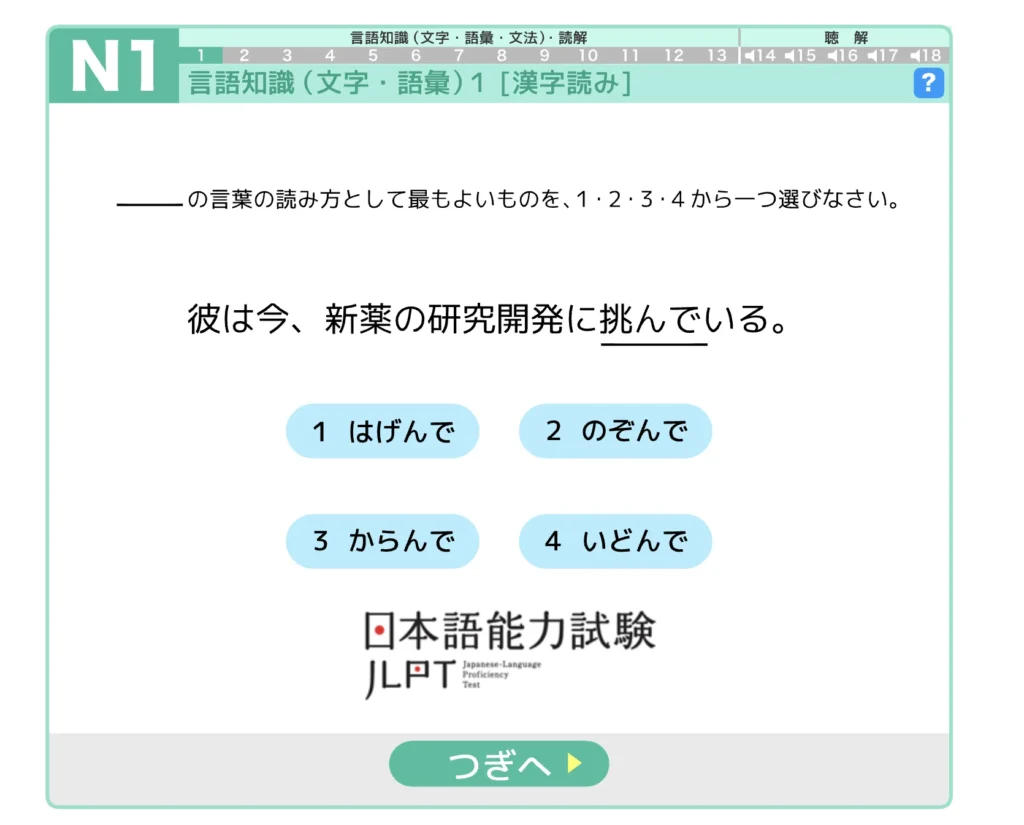
The Japanese-Language Proficiency Test (JLPT) is the most recognized exam worldwide for evaluating Japanese language ability. It measures grammar, vocabulary, listening, and reading skills across five levels, from N5 (beginner) to N1 (advanced).
What is the JLPT?
The JLPT was established in 1984 and is jointly administered by the Japan Foundation and the Japan Educational Exchanges and Services (JEES). It serves as the official qualification to certify Japanese proficiency for study, work, and immigration purposes.
JLPT levels and structure
The JLPT consists of five levels: N5, N4, N3, N2, and N1. The N5 level corresponds approximately to A1–A2 on the CEFR scale, making it ideal for beginners seeking official certification of basic Japanese skills.
N5 (Beginner) tests your understanding of simple expressions, short conversations, and basic written Japanese using hiragana, katakana, and basic kanji.
- Language Knowledge (Vocabulary & Grammar): 25 minutes
- Reading: 40 minutes
- Listening: 30 minutes
Total duration: approximately 95 minutes.
Why take the JLPT?
- Global recognition: accepted by universities, employers, and government institutions in Japan and abroad.
- Objective evaluation: provides an internationally standardized measurement of Japanese proficiency.
- Motivation: gives learners a clear goal and structure for progress.
- No speaking section: focuses on reading and listening, suitable for self-study learners.
Test dates and registration
The JLPT is offered twice a year (July and December) in Japan and in many other countries. Some locations hold it only once per year.
- Registration is handled by each local test center.
- Fees vary by country (usually between USD 50–80).
- Results are typically released about two months after the test date.
Find test centers and registration details here:
JLPT Test Centers Worldwide
Scoring and results
Each section (Language Knowledge, Reading, and Listening) is scored out of 60 points, for a total of 180. To pass, candidates must:
- Reach the overall passing score (e.g., 80/180 for N5).
- Meet the minimum score per section (19 points for N5).
Certificates are valid indefinitely and can be used for academic, professional, or immigration purposes.
How to prepare for the JLPT N5
- Study basic grammar, vocabulary, and around 100 kanji characters.
- Practice using official sample questions provided by the JLPT:
- Use online resources, textbooks, and listening materials focused on beginner Japanese.
- Reinforce vocabulary and sentence patterns daily with A1 Polyglot Phrases.
Alternative Japanese exams
Besides the JLPT, other tests such as the J-Test (Practical Japanese Test) and the NAT-Test also measure Japanese ability. However, the JLPT remains the most widely recognized certification by educational and government institutions.
Quick links
Note: test dates, fees, and application procedures may vary by country. Always confirm details with your local JLPT host institution.