




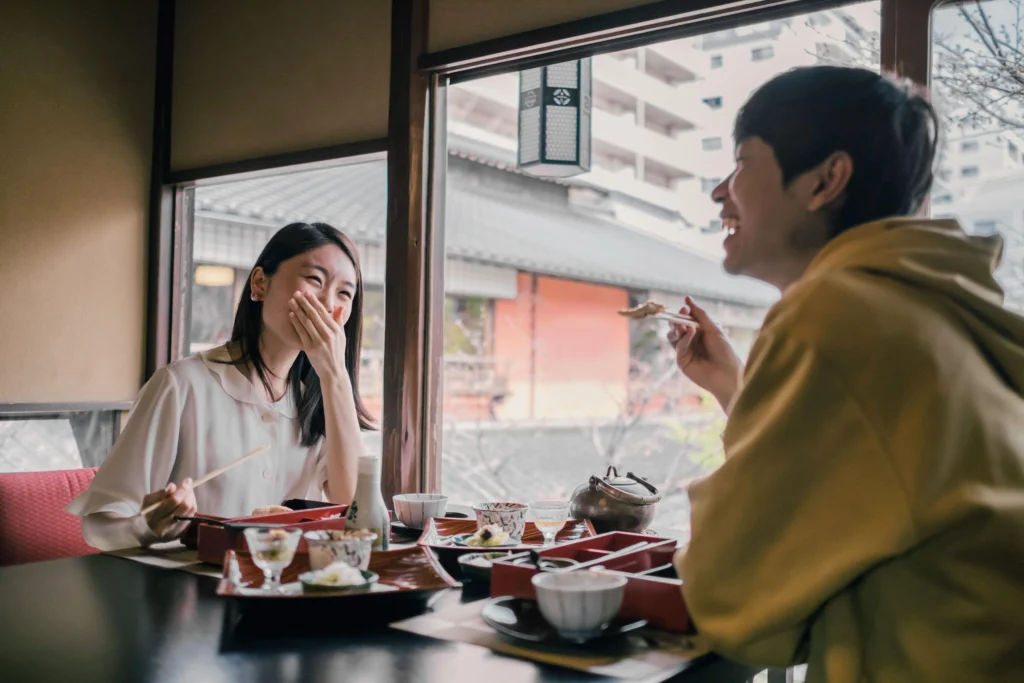
두 친구가 식당에서 주문합니다.
Two friends order food at a restaurant.
Conversation
Customer 1
안녕하세요!
(Annyeonghaseyo!)
Hello!
Customer 2
자리 있어요?
(Jari isseoyo?)
Is there a seat?
Waiter
네, 여기 앉으세요.
(Ne, yeogi anjeuseyo.)
Yes, please sit here.
Customer 1
감사합니다.
(Gamsahamnida.)
Thank you.
Customer 2
메뉴 주세요.
(Menyu juseyo.)
Please give me the menu.
Waiter
여기요.
(Yeogiyo.)
Here you go.
Customer 1
저는 비빔밥 주세요.
(Jeoneun bibimbap juseyo.)
I'll have bibimbap, please.
Customer 2
저는 김치찌개 주세요.
(Jeoneun gimchijjigae juseyo.)
I'll have kimchi stew, please.
Customer 1
물도 주세요.
(Muldo juseyo.)
Water, please.
Waiter
네, 알겠습니다.
(Ne, algesseumnida.)
Yes, I understand.
Customer 2
음식 맛있어요?
(Eumsik masisseoyo?)
Is the food delicious?
Customer 1
네, 맛있어요!
(Ne, masisseoyo!)
Yes, it's delicious!
Waiter
더 필요한 거 있으세요?
(Deo piryohan geo isseuseyo?)
Do you need anything else?
Customer 1
아니요, 괜찮아요.
(Aniyo, gwaenchanayo.)
No, I'm okay.
Key Vocabulary
- 안녕하세요 (Annyeonghaseyo) — Hello
- 자리 (jari) — seat
- 있어요 (isseoyo) — is there / do you have
- 앉으세요 (anjeuseyo) — please sit
- 감사합니다 (Gamsahamnida) — Thank you
- 메뉴 (menyu) — menu
- 주세요 (juseyo) — please give me
- 여기요 (yeogiyo) — Here you go / Excuse me
- 비빔밥 (bibimbap) — bibimbap (Korean mixed rice dish)
- 김치찌개 (gimchijjigae) — kimchi stew
- 물 (mul) — water
- 맛있어요 (masisseoyo) — It's delicious
Grammar Notes
-세요 / -(으)세요 (Polite imperative)
This ending is added to verb stems to form polite commands or requests. Use -세요 after a verb stem ending in a vowel, and -으세요 after a verb stem ending in a consonant.
Example: “앉으세요 (please sit), 주세요 (please give)”
-도 (also, too)
This particle is attached to nouns or pronouns to mean 'also' or 'too'.
Example: “물도 주세요. (Water, please / Give me water, too.)”
Noun + 있어요 / 없어요 (To have / To not have, To exist / To not exist)
Used to express existence or possession. '있어요' means 'there is/are' or 'I have', and '없어요' means 'there isn't/aren't' or 'I don't have'.
Example: “자리 있어요? (Is there a seat?)”