


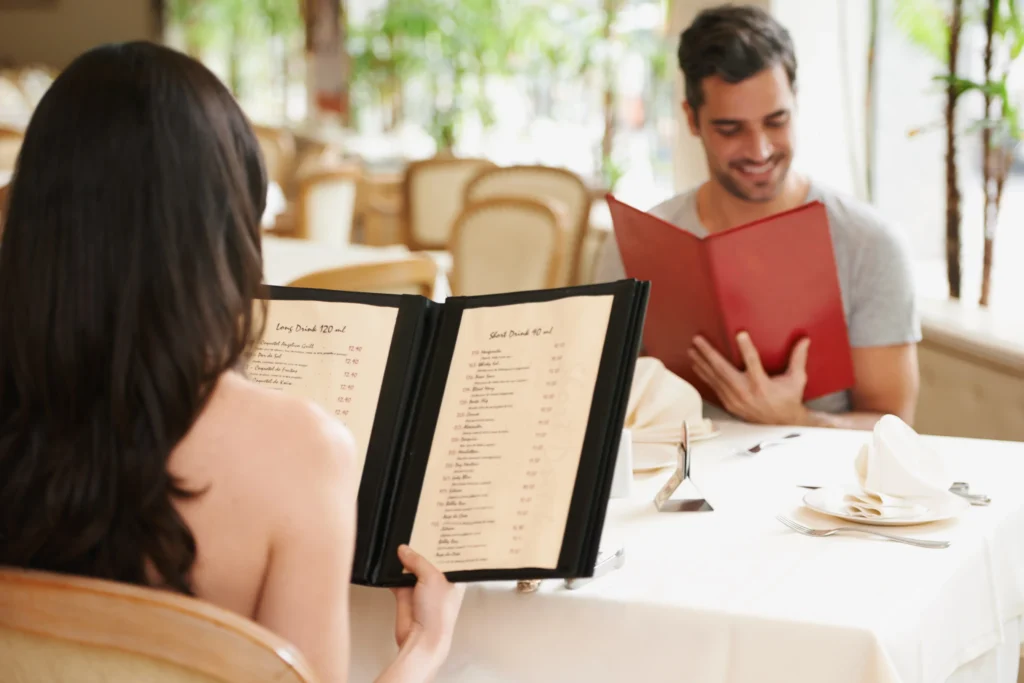
Zwei Freunde essen in einem Restaurant.
Two friends are eating at a restaurant.
Conversation
Waiter
Guten Tag! Haben Sie einen Tisch?
Good day! Do you have a table?
Customer 1
Ja, bitte. Für zwei Personen.
Yes, please. For two people.
Waiter
Hier, bitte. Die Speisekarte.
Here you go. The menu.
Customer 1
Danke schön.
Thank you very much.
Customer 2
Ich nehme den Salat.
I'll take the salad.
Customer 1
Ich möchte die Pizza.
I would like the pizza.
Waiter
Und zu trinken?
And to drink?
Customer 2
Ein Wasser, bitte.
A water, please.
Customer 1
Ich nehme eine Cola.
I'll take a coke.
Waiter
Kommt sofort!
Coming right up!
Customer 1
Der Salat sieht gut aus!
The salad looks good!
Customer 2
Ja, und die Pizza auch.
Yes, and the pizza too.
Key Vocabulary
- Guten Tag — Good day
- ein Tisch — a table
- bitte — please
- für — for
- zwei Personen — two people
- die Speisekarte — the menu
- Danke schön — Thank you very much
- Ich nehme — I'll take
- der Salat — the salad
- die Pizza — the pizza
- zu trinken — to drink
- ein Wasser — a water
Grammar Notes
Formal 'Sie' vs. informal 'du'
In German, 'Sie' is the formal 'you' used with strangers or in formal settings, while 'du' is informal. The waiter uses 'Sie' with the customers.
Example: “Haben Sie einen Tisch?”
Verb 'nehmen' (to take)
The verb 'nehmen' is used to express 'I'll take' when ordering food or drinks.
Example: “Ich nehme den Salat.”
Definite and Indefinite Articles (der, die, das, ein, eine)
German nouns have genders (masculine, feminine, neuter) which determine their definite (the) and indefinite (a/an) articles. 'Der' is masculine, 'die' is feminine, 'das' is neuter. 'Ein' is for masculine/neuter, 'eine' for feminine.
Example: “Der Salat (masculine), die Pizza (feminine), ein Wasser (neuter)”