


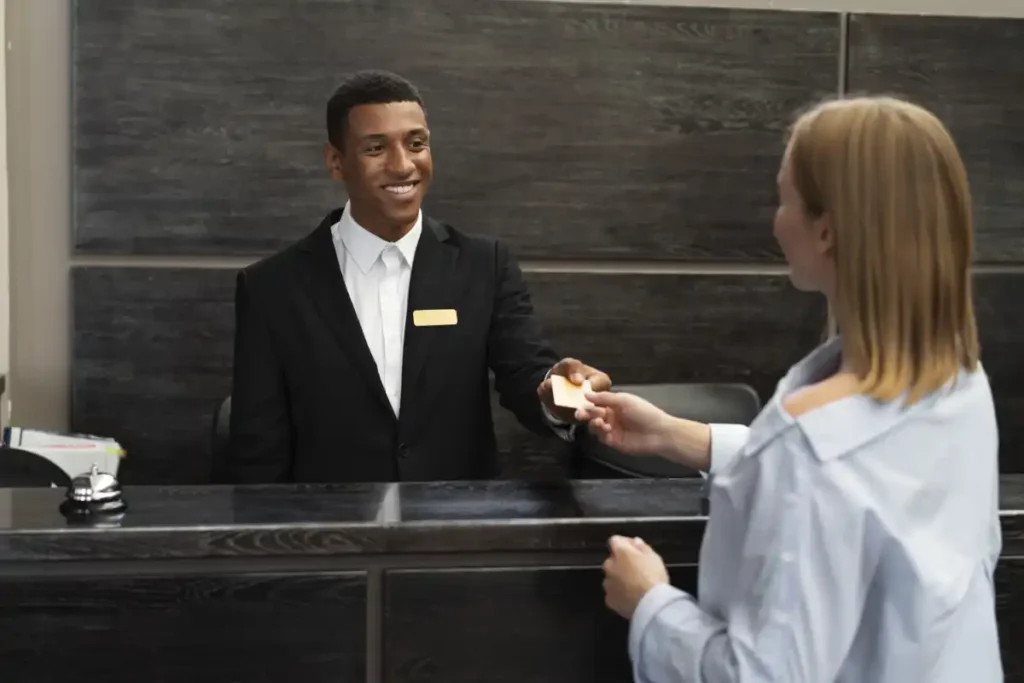
Uma conversa simples na recepção de um hotel.
A simple conversation at a hotel reception.
Conversation
Hotel Guest
Olá. Eu tenho uma reserva.
Hello. I have a reservation.
Receptionist
Bom dia! Qual é o seu nome, por favor?
Good morning! What is your name, please?
Hotel Guest
Meu nome é Ana Silva.
My name is Ana Silva.
Receptionist
Ana Silva. Um momento, por favor.
Ana Silva. One moment, please.
Receptionist
Sim, aqui está. Quarto número três zero um.
Yes, here it is. Room number three zero one.
Hotel Guest
Obrigada. Onde é o café da manhã?
Thank you. Where is breakfast?
Receptionist
O café da manhã é no primeiro andar.
Breakfast is on the first floor.
Hotel Guest
Que horas é o café da manhã?
What time is breakfast?
Receptionist
É das sete às dez horas.
It's from seven to ten o'clock.
Hotel Guest
Certo. Tem Wi-Fi?
Okay. Do you have Wi-Fi?
Receptionist
Sim, o Wi-Fi é gratuito.
Yes, the Wi-Fi is free.
Hotel Guest
Ótimo! Muito obrigada.
Great! Thank you very much.
Receptionist
De nada. Tenha uma boa estadia!
You're welcome. Have a good stay!
Key Vocabulary
- Olá — Hello / Hi
- reserva — reservation
- Bom dia — Good morning
- nome — name
- Um momento, por favor — One moment, please
- quarto — room
- Obrigada — Thank you (female speaker)
- café da manhã — breakfast
- primeiro andar — first floor
- Que horas é? — What time is it?
- gratuito — free
- De nada — You're welcome
Grammar Notes
To be (Ser/Estar)
In Portuguese, 'ser' and 'estar' both mean 'to be'. 'Ser' is used for permanent characteristics or identity (e.g., Ana is called Ana). 'Estar' is used for temporary states or locations (e.g., the Wi-Fi is free, or the breakfast is on the first floor).
Example: “Meu nome *é* Ana Silva. (identity) O café da manhã *é* no primeiro andar. (location)”
Asking 'What time is…?'
To ask about the time of an event, you can use 'Que horas é…?' (What time is…?).
Example: “*Que horas é* o café da manhã?”