




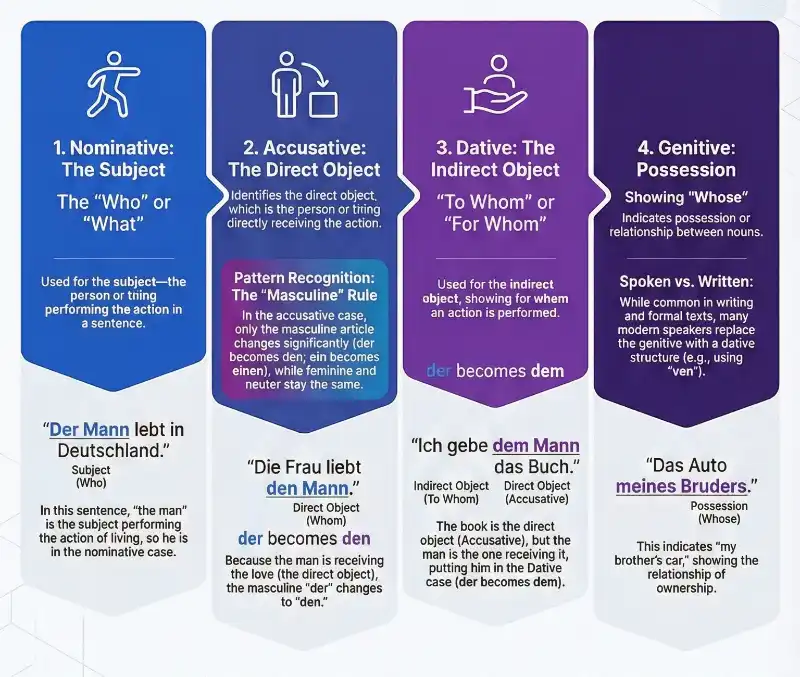
In German, nouns change depending on the role they play in a sentence.
This change is called a case.
Most of the time, the noun itself does not change.
What changes is the article in front of it.
German has four cases:
- Nominative
- Accusative
- Dative, and
- Genitive
At first, this sounds intimidating.
In reality, cases are just a way to show who does what to whom.
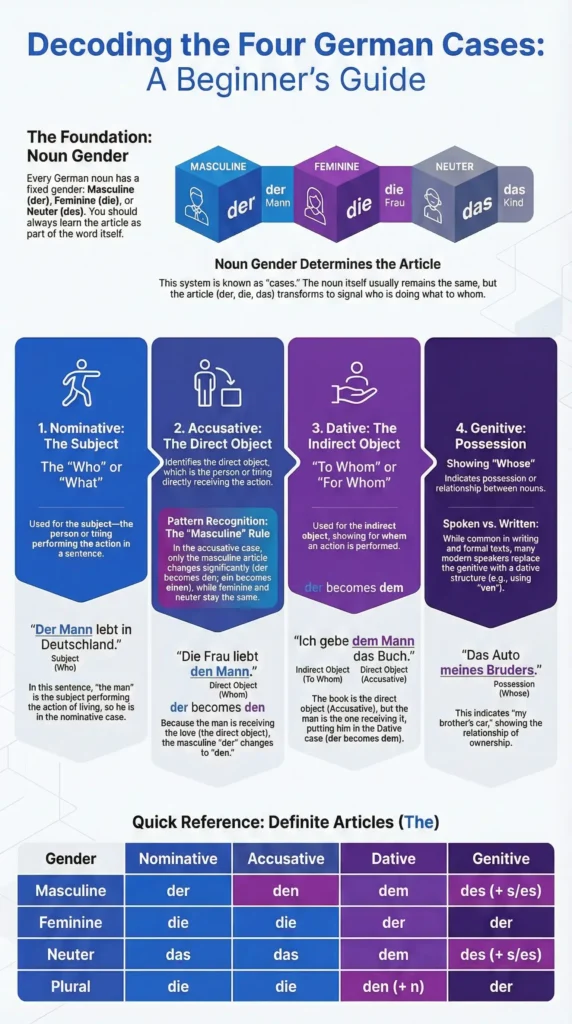
German nouns have gender
Before understanding cases, one thing is essential.
Every German noun has a gender:
- Masculine: der
- Feminine: die
- Neuter: das
Examples:
der Mann (the man)
die Frau (the woman)
das Kind (the child)
When you learn a new word in German, you should always learn it with its article.
The article is part of the word.
The nominative case
The subject of the sentence
The nominative case is used for the subject, the person or thing that performs the action.
It answers the question:
Who? What?
Examples:
Der Mann lebt in Deutschland.
The man lives in Germany.
Die Frau arbeitet in der Bäckerei.
The woman works in the bakery.
Das Kind geht in die Schule.
The child goes to school.
This is the basic form of the article and the easiest case to recognize.
Articles in the nominative case
der, die, das, die (plural)
ein, eine, ein
Meaning: the
They are used when we talk about something specific or already known.
der Mann
the man
die Frau
the woman
das Kind
the child
die Kinder
the children
The accusative case
The direct object
The accusative case is used for the direct object, the person or thing that directly receives the action.
It answers the question:
Whom? What?
Examples:
Das Kind isst einen Apfel.
The child eats an apple.
Der Mann liebt die Frau.
The man loves the woman.
Die Frau liebt den Mann.
The woman loves the man.
Indefinite articles in the accusative case
The table below shows how the indefinite article ein / eine changes in the accusative case. You are not expected to learn the entire table now.
At this stage, focus on recognizing one key pattern: only the masculine form changes clearly. This change is what helps you identify the direct object in a sentence and understand who is affected by the action.
| Gender | Nominative | Accusative | Dative | Genitive |
| Masculine | ein | einen | einem | eines |
| Feminine | eine | eine | einer | einer |
| Neuter | ein | ein | einem | eines |
Indefinite Articles Table (A/An)
Important note:
Only the masculine article clearly changes.
der → den
ein → einen
This is normal. With repetition, it becomes natural.
The dative case
The indirect object
The dative case is used for the indirect object.
It shows to whom or for whom something is done.
It answers the question:
To whom? For whom?
Examples:
Ich gebe dem Mann das Buch.
I give the book to the man.
Here:
das Buch is the direct object (accusative)
dem Mann is the indirect object (dative)
Another example:
Ich schenke der Frau eine Blume.
I give a flower to the woman.
A useful mental rule:
When something is given, sent, shown, or told to someone, that person is usually in the dative case.
The genitive case
Possession and belonging
The genitive case shows possession or relationship.
It answers the question:
Whose?
Examples:
Das Auto meines Bruders.
My brother’s car.
Die Spielsachen des Kindes.
The child’s toys.
Das Buch meiner Schwester.
My sister’s book.
In modern spoken German, the genitive is used less often.
Many speakers replace it with a dative structure.
Example:
Das Auto von meinem Bruder.
The car of my brother.
You will still see the genitive frequently in writing, books, and formal texts.
A simple way to remember the cases
Nominative: who does the action
Accusative: what or whom is affected directly
Dative: to whom the action is directed
Genitive: whose something is
If you understand this logic, the tables start to make sense.
An important learning tip
Learning German cases is not about memorizing charts.
It is about seeing them again and again in real sentences.
At first, you do not fully understand them.
You recognize them.
Then, without realizing it, you start using them correctly.
That is how real learning happens.
Reference table for German cases
The table below is not something you are expected to memorize now. It exists as a reference, a way to recognize patterns when you meet them in real sentences.
German cases make sense slowly, through exposure, not through effort alone.
At first, you simply notice these forms. Later, they begin to feel familiar. Only after that do they become natural. Use this table as a guide, not a test.
| Gender | Nominative | Accusative | Dative | Genitive |
| Masculine | der | den | dem | des (+ s/es) |
| Feminine | die | die | der | der |
| Neuter | das | das | dem | des (+ s/es) |
| Plural | die | die | den (+ n) | der |
Definite Articles Table (The)