





From the earliest civilizations, mastery of language has been seen not merely as a skill, but as a sign of higher intelligence. Those who spoke many tongues were often viewed as enlightened beings, bridges between cultures, interpreters of truth, and custodians of knowledge. In ancient societies, to know multiple languages was to command access to multiple worlds.
In Mesopotamia and Egypt, scribes and scholars who mastered several languages held privileged positions. They translated trade documents, royal decrees, and sacred texts, preserving connections across regions and generations. The Library of Ashurbanipal in Nineveh (7th century BCE) stands as one of the earliest monuments to linguistic learning. Its clay tablets contained works in Sumerian, Akkadian, and Babylonian, and many tablets were themselves translations of older writings. The ability to read and translate these texts was synonymous with wisdom and divine favor; Ashurbanipal even boasted that he could read “inscriptions from before the Flood.”
In ancient Greece, wisdom and language were deeply intertwined. The philosopher Heraclitus taught that understanding comes through logos, the word, or reason itself. To know language was to know the world. Greek educators saw rhetoric, grammar, and philosophy as inseparable, forming the trivium that shaped intellectual life for centuries. Later, the Hellenistic scholars of Alexandria mastered multiple languages to preserve and compare knowledge. At the Library of Alexandria, translators rendered Egyptian, Babylonian, and Hebrew works into Greek, believing that no culture’s wisdom should be lost to time. The act of translation became a sacred pursuit, the belief that truth could be multiplied through language rather than divided by it.
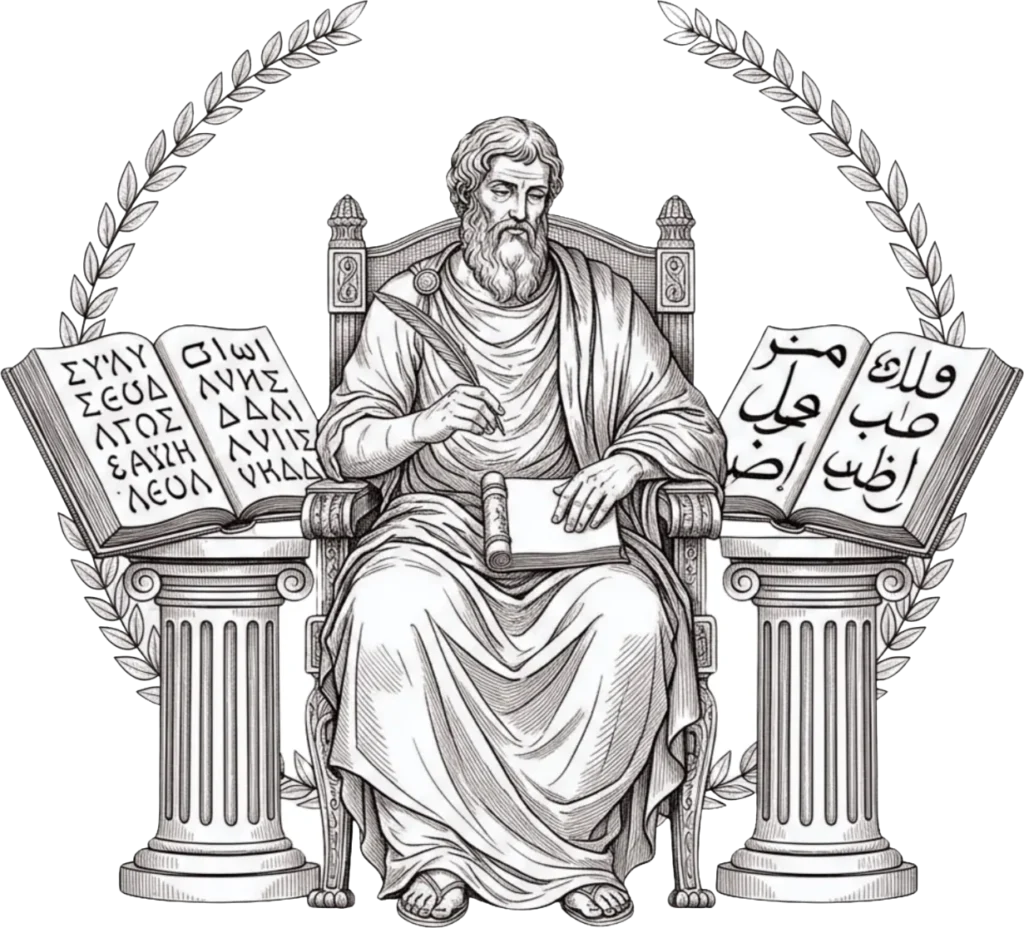

In the Near East, Jewish scholars cultivated a similar ideal. Mastery of Hebrew, Aramaic, and later Greek or Latin was essential to preserving sacred law. The translators of the Septuagint—the Greek version of the Hebrew Bible, completed in Alexandria around the 3rd century BCE, were celebrated as divinely inspired. According to tradition, seventy-two scholars translated the Torah independently, yet their versions miraculously agreed word for word. This story, whether symbolic or not, reflects how multilingual knowledge was equated with divine harmony and intellectual perfection.
In Asia, polyglotism also marked the wise and the holy. Ancient Buddhist monks who spread the Dharma from India to Central and East Asia translated scriptures into Sanskrit, Pali, Chinese, and Tibetan. Their work created vast linguistic networks of learning. Figures like Xuanzang, the 7th-century Chinese monk, traveled thousands of kilometers to India to master Sanskrit and bring back Buddhist texts. In doing so, he not only transmitted doctrine but also enriched Chinese language and culture. To be multilingual, in these traditions, was to seek enlightenment itself, a mastery of both language and meaning.


During the Roman and early Christian periods, the image of the polyglot philosopher and theologian became a moral ideal. Cicero equated eloquence with virtue, arguing that clear speech reflected clear thought. Later, Saint Jerome, translator of the Latin Vulgate Bible, became the emblem of sacred scholarship. His command of Latin, Greek, and Hebrew turned him into a bridge between worlds of faith and intellect. For medieval scholars who followed, Jerome’s trilingualism represented the pinnacle of wisdom: to know many languages was to glimpse the mind of God.
Across cultures, from Nineveh to Alexandria, from Nalanda to Rome, polyglotism became a universal metaphor for wisdom. It represented not only knowledge of words, but an expanded awareness of humanity itself. Each new language opened another lens on reality, another way of seeing and feeling.
Today, this ancient idea endures. Modern research in linguistics and neuroscience confirms that learning multiple languages strengthens memory, creativity, and cognitive flexibility (American Psychological Association). Yet beyond the science, the old symbolism remains: to speak many languages is to cultivate empathy, perspective, and humility. Polyglotism is not only the art of speaking, it is the art of understanding.